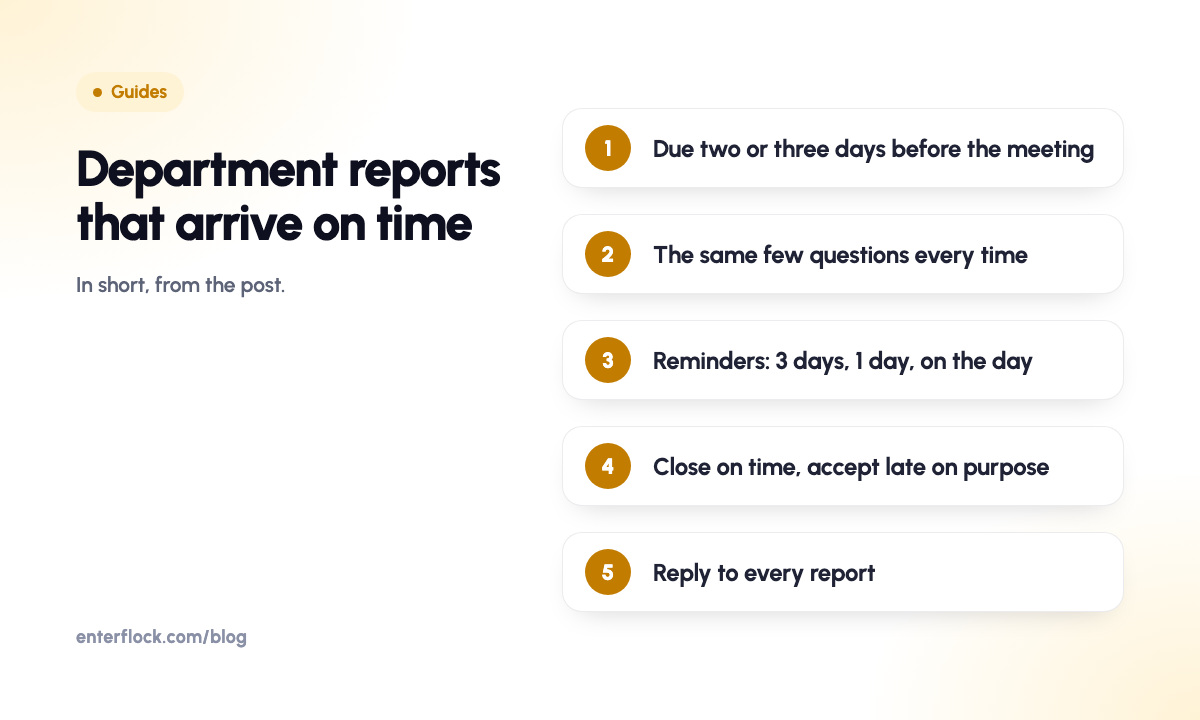
To get church department reports in on time, give every report a due date a few days before the meeting it feeds, remind people before it is due, and close it at the deadline, with a deliberate way to accept a late one. Ask fewer, sharper questions so a report takes minutes rather than an evening, keep every submission in one place, and make sure someone reads each report and replies. Late reports are rarely a discipline problem. They are usually a process with no edges.
The church and people below are a composite, but most church secretaries will recognise the night before the meeting.
Midnight before the leaders' meeting
Chinedu was the church secretary, which in practice meant he was the person who turned eight department reports into one document before the monthly leaders' meeting on Saturday morning.
On Friday at eleven at night he had three. The youth report had arrived as a voice note. The choir report was a photograph of a handwritten page, taken at an angle. The ushers had sent nothing, and their head was not answering his calls. Two other departments had replied "will send tomorrow", which meant during the meeting.
He gave up at one in the morning and printed what he had. At the meeting, half the time went on departments explaining what their report would have said. The leaders pushed every decision that needed numbers, such as whether the youth retreat could go ahead, to next month.
The following month, the same thing happened.
Why department reports arrive late
Nobody on Chinedu's leadership team was careless. They were busy volunteers with jobs and families, being asked to produce something with no clear shape, no fixed deadline and no consequence for missing it. In that situation, late is the rational outcome:
- The deadline was the meeting itself, so there was never time to compile anything.
- Every report looked different, so nobody knew when they had finished.
- There were no reminders, so the report came to mind on Friday night or not at all.
- A late report was always accepted, so the deadline meant nothing.
Set the due date before the meeting, not on it
A report is due when the person who needs it can still use it. For a monthly meeting, that usually means two or three days beforehand. It gives the secretary time to read everything, and the pastor time to spot the question that needs answering before it is asked in the room.
Put the due date on every request for department reports in writing, with a day and a time. "By Thursday evening" is a deadline. "Before the meeting" is a hope.
Ask the same few questions every time
A blank page is the hardest thing to fill in. Give every department the same short template, with questions that can be answered in a sentence or a number:
- What happened this month? Attendance, events, anything notable.
- What went well, and what did not?
- What money came in or went out, if any?
- What do you need from leadership?
Keep it short enough to complete in ten minutes. If a department has more to say, it can say it, but the minimum should never feel like an evening's work. Asking the same questions every month has a quieter benefit too: after a year, you can put the reports side by side and see a trend instead of twelve unrelated documents.
Remind people before it is due
Most late department reports are forgotten, not refused. A reminder a few days before the deadline, another the day before and a last one on the day catches nearly all of them. It needs to go to the person responsible for the report, not to a group chat where everyone assumes someone else will answer.
Close it at the deadline, and accept late on purpose
This is the step most churches skip, and it is the one that makes the others work. When the deadline passes, the report closes. A late report can still come in, but only when someone deliberately decides to accept it.
That sounds strict. In practice it is kind. It means the deadline is real, so people plan for it. And it means accepting a late report is a conscious act of grace, "the youth leader was away, let them submit it", rather than the default that quietly trains everyone to be late.
Keep every report in one place
Department reports scattered across six phones as voice notes, photographs and emails cannot be compared, searched or kept. Whatever you use, every department should submit into the same place, in the same shape, so the secretary is reading reports, not assembling them.
Read them and reply
The fastest way to make sure department reports stop arriving is to never respond to them. If a department head writes that the children's ministry needs two more volunteers and hears nothing, next month's report will be shorter. Acknowledge every report. Where something needs more detail, ask for changes with a short note rather than raising it for the first time in the meeting.
What changed for Chinedu
- Reports were due on Thursday at eight in the evening, two days before the meeting.
- Every department answered the same four questions.
- Reminders went out three days before, the day before and on the day.
- At the deadline, the report closed. Chinedu could accept a late one with a click when there was a good reason.
- Each report got a reply, and some got a request for more detail before Saturday.
By the third month, seven of eight departments were in by Thursday night. Chinedu went to bed at a normal hour on Friday, and the leaders decided the youth retreat in the first ten minutes of the meeting, because the numbers were already on the table.
If your reports and records still live in spreadsheets and chat threads, here are some signs it might be time to move.
Flock gives every report a due date, sends reminders three days before, the day before and on the day, closes the report at the deadline with an "Accept late" option, and lets reviewers request changes with a note. Past reports sit side by side by year. Reports are available on every plan, including the free one. Details are on the pricing page, and starting is free.