Follow up with a first-time visitor within two days, from a named person, with one personal message and one clear next step. Then watch for their second visit, because that is the moment they decide whether this church noticed them. Most churches do the welcome well. Where first-time visitor follow-up breaks is the gap between the first visit and the second, when the visitor's name belongs to nobody in particular.
Here is how that gap opens, and how to close it. The church and the people below are a composite, though every church we have spoken to recognised the basket.
The card in the basket
Tolu moved to a new part of town in March and, three weeks in, walked into Hope Chapel on a rainy morning because it was the nearest church with its lights on. An usher smiled at her, handed her a welcome card and a pen, and pointed to a basket by the door. She filled in her name, her phone number and, after a moment, ticked the box that said I would like someone to contact me.
The basket went to the church office on Monday. On Monday the church office was one volunteer, Mrs Adeyemi, who also counted the offering, printed the bulletin and answered the phone. The cards went into a drawer with the intention of a phone call that week.
Tolu came back eleven days later. She sat in the same row. Nobody greeted her by name, because nobody knew it. The usher was a different usher. The card was still in the drawer.
She did not come a third time. Nobody at Hope Chapel ever knew she had come twice.
Why the welcome is not the problem
Hope Chapel was warm. The usher was kind, the service was good and the card asked the right questions. Nothing about the first visit failed.
What failed was ownership. A card that goes into a shared basket belongs to the church, and in practice a thing that belongs to the church belongs to whoever has a spare hour. On a busy week, nobody does. The welcome happened in public, where everyone could see it. The follow-up was meant to happen in private, where nobody would notice if it did not.
So the fix is not a better card. It is making sure every visitor's name lands in a place someone is responsible for, on the day they visit.
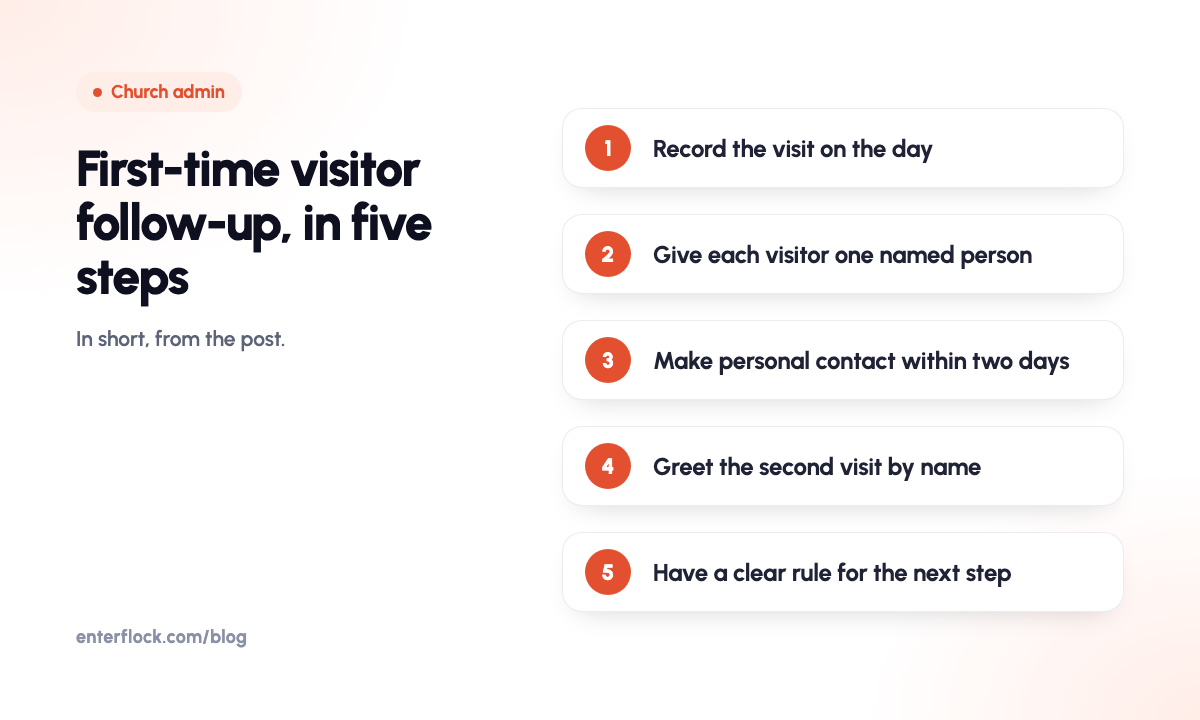
Record the visit on the day
A first-time visitor's details are perishable. Handwriting gets harder to read, the context fades, and by Thursday nobody remembers which card was the young couple who mentioned they had just had a baby.
- Capture it before people leave. A paper card is fine if someone types it up that afternoon. A QR code at the welcome desk that opens a short form is better, because the visitor types their own phone number and the spelling is theirs.
- Keep it short. Name, a way to reach them, and whether they want to be contacted. Every extra question is a reason to leave the card blank.
- Record it as a visit, not just a contact. The point is not a list of phone numbers. It is knowing that this person was here on this day, so you can see it when they come back.
Give every first-time visitor one named person
The single biggest improvement most churches can make is to assign each first-time visitor to one person before the end of the day. Not a team. A person, with a name, who knows the visitor is theirs.
That person does not need to be on staff. In many churches the best follow-up comes from a member of a similar age or stage of life, who can say "I am new-ish here too" and mean it. What matters is that if the follow-up does not happen, it is obvious who to ask.
Make the first contact within two days
Aim for contact within forty-eight hours, while the visit is still fresh for them as well as you.
- Make it personal. "Hi Tolu, it was lovely to have you on Sunday. I am Sade from Hope Chapel" lands very differently from a message that could have gone to anyone.
- Offer one next step, not five. A coffee after the next service, a midweek group, or simply "save my number in case you have questions". A list of every ministry the church runs reads like homework.
- Respect the tick box. If they did not ask to be contacted, a single short thank-you is enough. Pressure is the fastest way to lose a visitor who was only testing the water.
Treat the second visit as the signal
A first visit can mean anything: curiosity, a friend's invitation, a wedding last month. A second visit means they are considering you. It deserves more attention than the first, and it usually gets less.
When a first-time visitor comes back, someone should know before the service ends. The best outcome is that the person assigned to them, or the usher at the door, greets them by name. "Tolu, you came back. I am so glad." It costs nothing and it is the moment most visitors decide whether they belong.
That only works if the second visit is recorded the same way as the first, which is why capturing attendance matters more than collecting cards. If you are still counting heads by hand, we compared manual and automated attendance tracking and when switching is worth it.
Decide when a visitor stops being a visitor
Churches are often vague about the line between a visitor and a member, and the vagueness is where people drift. Pick a simple rule and write it down. For example:
- First visit: welcome, record, assign a person, contact within two days.
- Second visit: greet by name, and invite them to one specific thing.
- Third or fourth visit: invite them to whatever your church uses as the door into belonging, such as a newcomers' class, a small group or a conversation with a pastor.
- After that: stop treating them as a guest. Ask whether they would like to become a member, and record the answer either way.
The numbers matter less than having them. A rule that everyone knows beats a perfect process that lives in one person's head.
A short checklist
- Every first-time visitor's details recorded on the day they visit.
- Every visitor assigned to one named person.
- First contact within two days, personal, with one next step.
- Second visits noticed while the visitor is still in the building.
- A written rule for when a visitor is invited further in.
Hope Chapel did not need more volunteers to keep Tolu. It needed her name to land somewhere that belonged to someone, and it needed to notice the second Sunday she walked in.
Flock records first-timers at check-in and follows them up automatically with a welcome series, so the first message goes out even in the week the office is one busy volunteer, and their visits sit on one member record from the first day. You can see how it fits together on the product page, and starting is free.