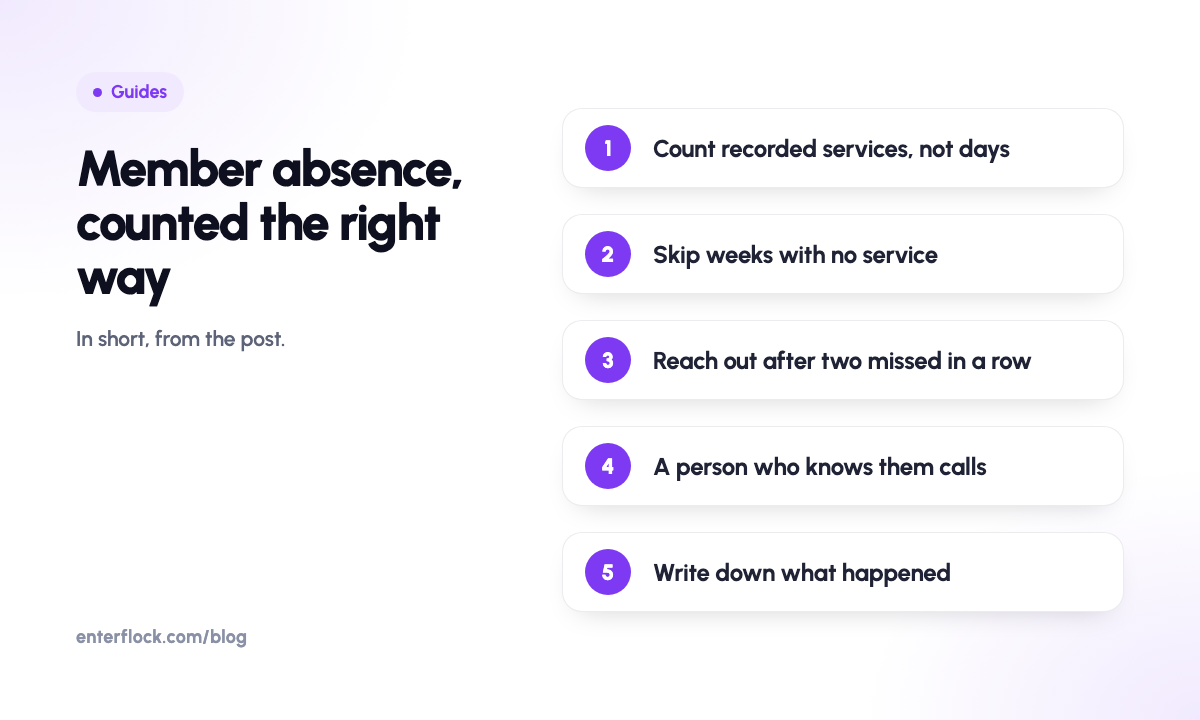
Track member absence by missed services, not by days since someone was last seen. Count the services your church actually held and recorded, on whatever day it meets, and treat two missed in a row as the point to reach out, with a call from someone who knows the person. A rule based on days fires when there was nothing to attend, and stays silent while a member drifts from every week to every third week.
The church below is a composite, but the holiday mistake in it happens somewhere every year.
The rule that fired over Christmas
Kemi looked after member care at a church of about three hundred. She wanted to stop finding out months later that someone had quietly stopped coming, so she set a simple member absence rule: anyone not seen for twenty-one days gets a phone call.
It worked for most of the autumn. Then the church took two weeks off over Christmas, with no midweek meeting and one combined service. On the first Sunday of January, Kemi's list held more than a hundred names. Faithful members, the choir, two of the elders. Her volunteers spent the week calling people to ask why they had been away from services that did not exist.
The next month the rule failed the other way. Mr Okafor, who had come every week for nine years, started coming every second or third week after his wife's surgery. He was never away for twenty-one days in a row, so he never appeared on the list. It was the pastor's wife who noticed, in March, that she had not spoken to him in a while.
The rule was wrong in both directions for the same reason. It measured the calendar instead of the church.
Member absence is a missed service, not a day
Member absence only means something when there was a chance to be present. If there was no service, nobody was absent. If there were two services in a week and someone came to neither, they missed two.
So the question to ask is not "how long since we last saw them?" but "how many of the services they would normally attend did they miss?" That one change fixes several problems at once:
- Holidays and cancellations stop counting. A week with no service is not a missed week.
- Your meeting day is respected. Plenty of churches meet on a Saturday, or treat a midweek meeting as the main gathering. A rule that quietly assumes Sunday will misread them every week.
- Gradual drift becomes visible. Missing one service in three is a pattern you can see when you count services. In days, it looks like nothing.
Only count what you recorded
This works only if attendance is recorded for the services that count. That does not have to mean every member checking in every time. It does mean deciding which gatherings matter for care purposes, usually the main weekly service and perhaps a midweek one, and recording attendance at those consistently.
A service where nobody took attendance should not count as one everybody missed. Treat it as unknown, not as absent. Otherwise one forgotten register produces a list of three hundred names, which is the Christmas problem again by a different route.
Two missed in a row is a sensible threshold
There is no perfect number for member absence, and you should adjust it to your church. Two consecutive missed services is a good starting point for most:
- One missed service is normal life: a cold, a shift at work, a family visit. Calling about one feels like surveillance.
- Two in a row is unusual enough to be worth a friendly word, and early enough that the person has not yet decided anything.
- A falling pattern, such as every week becoming every second or third week, deserves attention even if the person never misses two in a row. Look at the last eight or ten services, not just the last two.
The call should come from a person who knows them
A reminder email that says "we missed you" is better than nothing, but not by much. It tells the member the church noticed a gap in a spreadsheet. A call from someone they know tells them a person noticed them.
- Route it to care, not to the office. The administrator who spots the list is rarely the right person to ring. A small group leader, a deacon or a friend usually is.
- Lead with care, not attendance. "We have not seen you for a couple of weeks and I wanted to check you are all right" opens a door. "You have missed two services" closes one.
- Be ready for a real answer. Sometimes the answer is a new job. Sometimes it is illness, grief or a hurt that happened at church. The call is where you find out which.
Write down what happened
Record the outcome of each member absence follow-up, even briefly: reached, all well; reached, unwell, pastor to visit; no answer, try again Thursday. Without a note, the same person gets three calls from three volunteers, or none, because everyone assumed someone else had rung.
A note also protects the member. When someone has said "I am taking a few months out while my mother is ill", nobody should be calling them every fortnight to ask where they are.
How Kemi's rule changed
- Count only services the church held and recorded, on the days it meets.
- Flag two consecutive missed services, and anyone whose attendance is clearly falling.
- Send each flag to a named carer, not to a general inbox.
- Record the outcome, and pause follow-up for anyone who has explained an absence.
The following Christmas, her list on the first Sunday of January had no names on it. In February it had six, and one of them was a widower who had stopped coming after his wife died. Somebody called him that week.
If you are still keeping registers on paper, we looked at when moving attendance off paper is worth it.
Flock records attendance per service, by QR, kiosk or self check-in, and raises a follow-up task for your team when a member misses services you have recorded, so the call goes to a person rather than a reminder going to an inbox. The product page shows how it works, and starting is free.